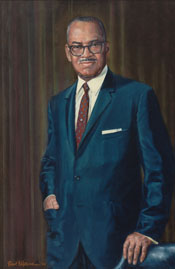
The third African American elected to Congress in the
twentieth century and the first Black Member to chair a
standing committee, William L. Dawson served in the
U.S. House of Representatives for nearly three decades.
A product of the influential Chicago Democratic machine,
Dawson was a champion of the cause of civil rights and
recognized the importance of working through institutional
channels in Congress to build power. Dawson, who was
known for his reserved demeanor and allegiance to the
Democratic Party, used the established seniority system of
the House of Representatives to amass legislative influence
on Capitol Hill. “A whole lot of publicity isn’t necessary to
get things done,” the Chicago Representative said. “Nine-tenths
of the work of Congress is done off the floor.”1
William Levi Dawson was born in Albany, Georgia, on
April 26, 1886, to Levi Dawson, a barber, and Rebecca
Kendrick. One of six siblings, Dawson credited his father and
sister with keeping his family together after his mother died
when he was a child. Upon graduating from Albany Normal
School in 1905, he worked his way through Fisk University
in Nashville, Tennessee, as a porter and a waiter. He
graduated in 1909 with a bachelor’s degree, and three years
later he moved to Chicago. After attending Kent College of Law and Northwestern University—both in Chicago—Dawson enlisted in the U.S. Army during World War I.
In 1917, at the age of 31, he became a first lieutenant with
the 365th Infantry of the American Expeditionary Force.
Dawson later noted that he was “above draft age and did not
have to go,” but he believed “it was the duty of every citizen
to rally to the colors in time of danger.” After returning to
Chicago, he resumed his studies at Northwestern and was
admitted to the Illinois bar in 1920. Dawson married Nellie
Brown on December 20, 1922, and the couple had two
children: William Dawson Jr. and Barbara.2
In 1928, Dawson waged an unsuccessful bid in the
Republican primary against incumbent Martin Barnaby
Madden for the congressional district that encompassed
numerous Black neighborhoods on Chicago’s South Side.
Undeterred by the loss, Dawson continued to pursue
a career in politics, becoming an ally of Chicago’s first
African-American alderman, Oscar De Priest, who later
won a special election to the House to fill the vacancy
left by Representative Madden’s death in 1928. In 1933,
with De Priest’s support, Dawson won election to the
Chicago city council. Two years later, backed by Chicago’s
Democratic mayor, Edward J. Kelly, Dawson won re-election to a four-year term; he served a total of six years as an alderman. In his second attempt to win a House seat
in 1938, Dawson defeated De Priest, who had lost his bid
for re-election to the House in 1934, in the Republican
primary. But Dawson lost to the incumbent Arthur W.
Mitchell in the general election, attracting about 47 percent
of the vote to Mitchell’s 53 percent. In a city struggling
with the economic effects of the Great Depression,
Black Chicagoans welcomed President Franklin D.
Roosevelt’s New Deal reforms. Dawson felt the pull of the
Democratic Party, the lure of patronage rewards within
the Democratic machine, and a general impatience with
the old guard of Black leaders tied to the GOP. Having
challenged De Priest, Dawson effectively severed his ties
to leading Black Republicans, who passed him over for the
party nomination for another term on the city council.
Running as an Independent, he failed to secure re-election.3
Dawson’s political career was revived in 1939 with his
acceptance of Mayor Kelly’s offer of the post of Democratic
committeeman for Chicago’s second ward. In line with
the growing shift of many African Americans from the
Republican to the Democratic Party, Dawson cited
President Roosevelt’s New Deal agenda as his primary
motivation for changing parties. As a committeeman,
Dawson efficiently organized his political base, using his
precinct workers to help transform other predominantly
Black wards into Democratic strongholds. In time,
Dawson’s followers controlled as many as five wards that
generally offered overwhelming majorities to local, state,
and national Democratic candidates.4
When Arthur Mitchell declined to seek a fifth term in
the House in 1942, Dawson opted for a third campaign
for a congressional seat—this time as a Democrat. With
the solid backing of the Democratic machine, Dawson
earned the party nomination by defeating Earl Dickerson,
a Chicago alderman. Dawson went on to beat Republican
William E. King, a former Illinois state senator and his
longtime political rival, in the general election—earning
53 percent of the vote.5
During his first two terms in office, Dawson served on
three committees: Coinage, Weights, and Measures; Invalid
Pensions; and Irrigation and Reclamation. He wanted
a seat on Judiciary Committee, but lost out to another
Illinois Representative, Martin Gorski. He also served on
the Expenditures in the Executive Departments Committee
from the 78th through the 80th Congress (1943–1949)
before ascending to committee chair in 1949; the committee
was renamed Government Operations in 1952. Dawson
held this leadership position for ten nonconsecutive terms,
only ceding the gavel for one term when Republicans briefly
assumed control of the House during the 83rd Congress
(1953–1955). Dawson’s historic chairmanship was celebrated
in the press and at a dinner in his honor hosted by leading
national and Illinois Democratic leaders. Dawson spent
15 years on the District of Columbia Committee from the
84th Congress to the 91st Congress (1955–1971), and he
also served on the Insular Affairs Committee—later named
Interior and Insular Affairs—for two brief stints during the
78th and 79th Congresses (1943–1947), and again during
the 82nd Congress (1951–1953).6
During his first term in the House, Dawson was the
only African American serving in Congress. On February 9,
1943, Dawson made his first speech on the House Floor. He
criticized the actions of the House Un-American Activities
Committee, which had accused a Black employee at the
U.S. Treasury Department, William Pickens, of harboring
Communist ties. Dawson called the accusations baseless and
declared the unquestioned loyalty of Pickens, who Dawson
had known for 40 years.7
During his tenure in the House, Dawson steadfastly
supported equal employment opportunities. He believed
“every American citizen is entitled to a job in this country,”
and introduced several fair employment bills between
1945 and 1949 to prohibit job discrimination based on
race or national origin. In 1944, he testified before the
House Labor Committee in support of similar legislation.
“The right to work is synonymous with the right to live,”
he declared.8
Dawson also vigorously opposed the use of the poll tax
by state governments and introduced bills to outlaw them
as a qualification for federal elections. After the House
passed an anti-poll tax bill in 1943, Dawson promoted
it before the Senate Judiciary Committee, where he
asserted that poll taxes were adopted for the “deliberate,
vicious, undemocratic purpose of disfranchising large
numbers of Negroes and white people because of their
economic status.”9
In 1944, a second Black Representative, Adam Clayton
Powell Jr. of New York, joined Dawson in Congress. Dawson
and Powell drew intense media attention and scrutiny
because of their strikingly different legislative styles. Powell,
who epitomized a more confrontational approach within the civil rights movement, criticized racial inequality, including segregation in certain areas of the Capitol, at
every conceivable opportunity. Unlike Powell, Dawson
disliked personal publicity, was wary of the media, and
lived unpretentiously. He personally attended to many of
the details of his office. When in his district, Dawson spent
part of each day at his headquarters listening to complaints,
requests, and opinions from his constituents. He kept a firm
grip on his share of power in Chicago, dispensing patronage
and favors through his political machine and its ancillary
organizations. Dawson worked behind the scenes to pass
legislation to assist his district, particularly as he gained
power in Congress.10
Throughout his 27 years in Congress, Dawson consistently
supported the interests of the Democratic Party. In 1948,
Dawson addressed the Democratic National Convention
in Philadelphia, praising President Harry S. Truman’s civil
rights record and taking the opportunity to denounce the
agenda of the Republican majority in the House. In 1950,
his unswerving loyalty to the party eventually led to a
position of national prominence: vice chair of the Democratic
National Committee (DNC). Dawson’s tenure as vice
chair was controversial at the time. The Democratic Party
simultaneously touted the appointment and tried to ward
off criticism from southern Democrats who objected to
Dawson’s prominent role in the party. Dawson did not
comment publicly on the controversy and largely avoided
confronting southern Democrats in the press.11
There was no equivocating on the appointment of
Dawson as chair of the House Committee on Expenditures
in the Executive Departments in 1949. The Illinois
Representative was well-positioned to eventually secure the
gavel and lead the panel as the third-ranking Democratic
member of the committee. Two significant changes in the
House Democratic Caucus led to his quick ascension to
the chair. First, Carter Manasco of Alabama, the ranking
Democrat on the committee in the 80th Congress (1947–
1949), lost his bid for re-election in 1948. Next in line was
Representative John W. McCormack of Massachusetts.
But when the Democrats took back the House majority
in the 81st Congress (1949−1951), McCormack was
elected Majority Leader and was therefore ineligible to
chair the committee. The start of Dawson’s chairmanship
in January 1949 led to howls of protest from southern
Democrats. Joseph Franklin Wilson of Texas resigned from
the committee rather than work under Dawson’s leadership, and several southern Democrats requested that Speaker Sam Rayburn of Texas intervene to force another appointment.
In a show of solidarity with Dawson, McCormack remained
on the committee despite the tradition of Majority Leaders
declining committee assignments.12
One of Dawson’s first legislative achievements as chair
was to shepherd through Congress President Truman’s plan
for reorganizing executive departments. Dawson sponsored
the Reorganization Act of 1949 and his committee held
hearings on the bill. It became law in June 1949. The act
enabled the President to create new agencies and restructure
existing departments, so long as plans were approved by
Congress. Both the House and Senate had 60 days to review
the President’s proposals, and either chamber reserved the
right to block their implementation.13
As chair of Government Operations, Dawson mainly
held hearings on federal spending and touted the millions
of dollars he claimed his committee saved the government
through its investigations. For instance, in 1957, the
committee began an inquest into federally funded
scientific research programs. Dawson was concerned that
within a federal department or agency, “such a program
can be seriously impeded by wasteful duplication,
excessive administration costs, complicated procedures,
and organizational financial bottlenecks.” In July 1958,
Dawson chaired the Government Operations subcommittee
hearing exploring the decision-making process for defense
spending. In 1966, Dawson’s committee criticized the federal
government’s research priorities after discovering that 90
percent of research and development funding was allocated
to nuclear energy, space, and defense programs. Meanwhile,
“civilian programs” to mitigate water pollution and address
urban housing and transportation issues were overlooked.
Dawson also led the Government Operations Subcommittee
on Executive and Legislative Reorganization from the 84th
to 89th Congresses (1955–1967). While Representative
Powell had served as chair of a special subcommittee in the
81st Congress, Dawson was the first Black Member to head
a formal subcommittee organized at the start of the session.14
In 1951, Dawson played an integral role ensuring
that the Universal Military Training Act furthered the
desegregation of the armed forces first initiated in 1948.
He helped defeat the Winstead amendment, proposed by
William Arthur Winstead of Mississippi, which would
have permitted military personnel to choose whether they
wanted to serve in White or Black units. Dawson spoke on the House Floor during the debate to urge his colleagues to end racial discrimination in the military, mentioning
that an injury he sustained during World War I would not
have become a lifelong affliction had he been allowed access
to a White hospital. Commenting proudly that he “led
Americans in battle,” Dawson proclaimed, “If there is one
place in America where there should not be segregation,
that place is in the armed services, among those who fight
for this country.”15
Dawson was often criticized for not fully employing
his authority as a committee chair and a leader of
the DNC to promote meaningful change for African
Americans. The NAACP condemned his “silence,
compromise and meaningless moderation” on issues
concerning African Americans, including his refusal to
back the Powell amendment, which prohibited federal
funding for segregated schools. Although Dawson opposed
the measure because he feared the rider would undermine
all aid to education, his caution disappointed many of his
own staff members. Powell intimated that his colleague cared
more about his position in Mayor Daley’s Chicago political
machine than the success of the civil rights movement—a
sentiment shared by other prominent Black leaders and civil
rights groups. But Dawson took a more pragmatic approach.
He viewed the political machine as an effective political
organizing tool in ward politics rather than an inherently
corrupt institution—and he questioned the need for the
type of outspoken activism associated with Powell. “The
world is full of orators, but it isn’t full of organizers,” he told
a reporter in 1946. “In this 2d Ward, we’ve got organizers.
I don’t need to make speeches to get out the vote.”16
After the murder of 14-year-old Emmett Till—a Chicago
resident who was visiting family in Mississippi—Dawson
was publicly chastised by the NAACP for neither speaking
out in defense of Till’s family nor denouncing his murder.
Dawson declined to respond to these allegations—an
approach that exacerbated criticism of the Chicago
Representative. Privately, however, Dawson worked behind
the scenes, helping Emmett Till’s mother, Mamie Bradley,
to convince Mississippi officials to release her son’s body
so that he could be buried in Illinois and he aided Bradley
with funeral arrangements.17
Dawson refuted detractors who accused him of failing to
adequately confront issues important to Black Americans.
“How is it,” he wondered, “that after fighting all my life for
the rights of my people, I suddenly awaken in the September
of life to find myself vilified and abused, and those who
know me well and what I have stood for are accusing me
of being against civil rights.” Reacting to criticism that his
infrequent speeches in Congress were a sign of ineffective
leadership, Dawson defended his approach to politics while
maligning some of his outspoken Black colleagues, noting,
“I use speeches only as the artisan does his stone, to build
something. I don’t talk just to show off.”18
Throughout his congressional career, Dawson balanced
his work in Washington with his determination to remain
influential in Chicago Democratic politics. He maintained
a strong presence in the city’s ward politics while serving in
Congress, doling out patronage positions and maintaining
a strong Democratic organization. He played a key role in
Richard J. Daley’s election as mayor of Chicago in 1955.
In 1960, President John F. Kennedy’s narrow victory in the
key state of Illinois was largely dependent on the voters in
Dawson’s wards. Dawson’s efforts to mobilize support for
Kennedy led to widespread speculation among the press that
the President-elect would express his gratitude by inviting
the Chicago Representative to become Postmaster General.
Kennedy did in fact offer the Chicago Representative the
position, but the 74-year-old Dawson declined, insisting
he would be more useful to the new administration as
a senior Member in the House. Some questioned the
authenticity of the offer, with the press insinuating that
the position was never intended for Dawson but instead
was a political maneuver to continue to build support
from Black Americans.19
Dawson introduced antilynching legislation several times
in the 1940s and 1950s. He also introduced a major civil
rights bill on the House Floor in 1963. His bill echoed
many of the proposals then being considered in Congress
and eventually rolled into the 1964 Civil Rights Act: voting
rights, the end to discrimination in public accommodations,
the creation of a Commission on Equal Employment
Opportunity, and a provision to prohibit discrimination in
federally funded programs. “There is a crisis in America that
is now a national danger,” he declared. “Unless something
is done about it, and it must be done soon, this crisis will
become a national calamity.”20
Despite his longevity and influence, Dawson never
assumed a leadership role among the small number of
African Americans in Congress. He clashed with the
confrontational spirit adopted by many Black leaders during
the 1960s. When Black Representatives began to organize and act collectively in 1969, Dawson declined to be part of the group. In May 1970—six months before his death—
he did join his Black colleagues in criticizing President
Richard M. Nixon for not agreeing to meet with them.21
As a loyal Democrat, Dawson supported the Vietnam
War and President Lyndon B. Johnson’s increasingly
unpopular foreign policy in Southeast Asia. In 1966, when
the Department of Defense reported that the death rate of
Black soldiers in Vietnam was higher than that of White
soldiers, Michigan Representatives John Conyers Jr. and
Charles C. Diggs Jr. expressed concern and called for further
investigation. Dawson considered the war an opportunity
for African Americans, who he said had “a great gain to
make in the present conflict” while noting that he had
not yet read the report. “When we are out there, carrying
our load and holding our own,” Dawson declared, “the
differences of race are wiped out.” From 1967 to 1968,
Dawson delayed the publication of a committee report
that was critical of Johnson administration policy on land
reform in Vietnam. John Emerson Moss of California, chair
of the Government Operations Subcommittee on Foreign
Operations and Government Information, had authored
a report that blamed the U.S. State Department and the
U.S. Agency for International Development for failing to
promote the redistribution of land from landlords to farmers
in South Vietnam. This process instead was implemented
by the Viet Cong in territory it controlled in South
Vietnam—a move calculated to further the organization’s
revolutionary goals at the expense of the anticommunist
forces. Dawson delayed publication of the report for five
months to avoid embarrassing the administration. Shortly
after, Dawson proposed to abolish the Foreign Operations
Subcommittee after the full committee’s budget was slashed.
Dawson said that the reorganization was necessary due
to lack of funding, but some suspected that he made the
decision at the request of the Johnson administration. The
reorganization plan was scrapped after the House approved
a higher budget for the committee.22
Dawson rarely faced any significant opposition to his
re-election. Several Black Republicans challenged him in the
1950s and 1960s, offering pointed critiques of his policy
choices and voting record. Regardless of the mounting
criticism against him, Dawson typically cruised to victory,
earning between 70 and 80 percent of the vote. His age
and his poor health—he had a stroke when he was 71 in
1957—prevented him from playing an active role on the
campaign trail in the 1960s. Nevertheless, he continued
to enjoy comfortable victories against his opponents in the
general election.23
By the end of his career, however, the Illinois
Representative found himself on the defensive for refusing
to disassociate himself from the Daley machine, which
by the late 1960s was widely perceived as insufficiently
committed to the cause of civil rights. He also faced
growing criticism from members of his own party and from
civil rights groups. For example, in 1966, he faced a primary
challenge from Fred Hubbard, a YMCA youth worker who
focused his campaign on framing Dawson as a machine
politician unfit to respond to the needs of the district.
Dawson remained in Washington during the lead-up to the
primary, unconcerned about his opponent, and Hubbard
dropped out of the race before the vote. In the general
election, the Congress of Racial Equality (CORE) and the
Student Nonviolent Coordinating Committee (SNCC)
organized for his Republican opponent, David Reed, yet
Dawson won easily. In their treatise on the significance of
the nascent Black Power movement, Stokely Carmichael
and Charles V. Hamilton wrote that Dawson had “become
assimilated” and allowed the White power structure in
the city of Chicago to rule over the Black community like
“Britain over the African colonies.”24
Dawson won again in 1968 before deciding to retire
at the conclusion of the 91st Congress (1969–1971). On
November 9, 1970, only six days after his handpicked
successor, Ralph H. Metcalfe, won election to his seat,
Dawson died of pneumonia in Chicago.25
[ Top ]