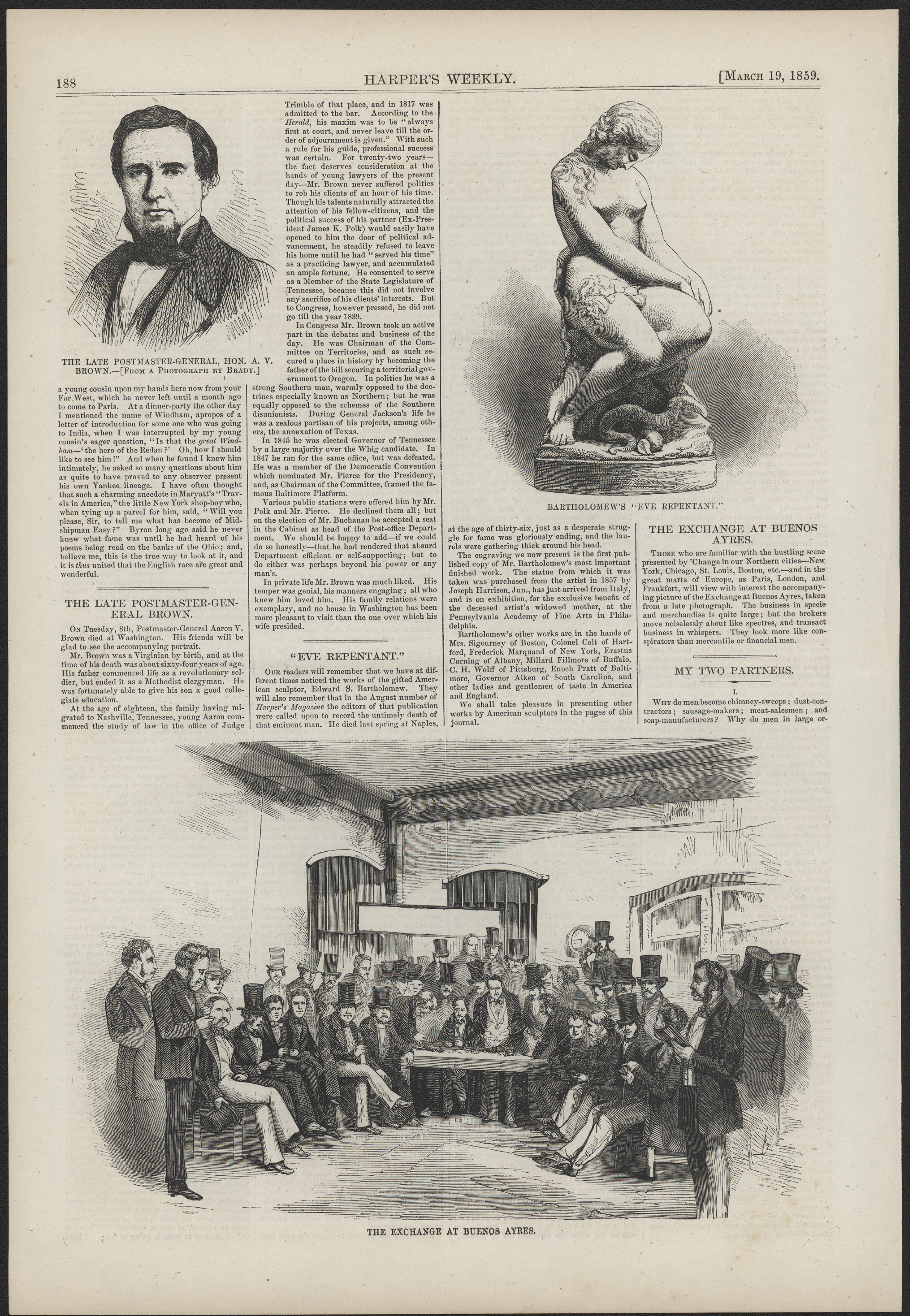
The Late Postmaster-General, Hon. A.V. Brown

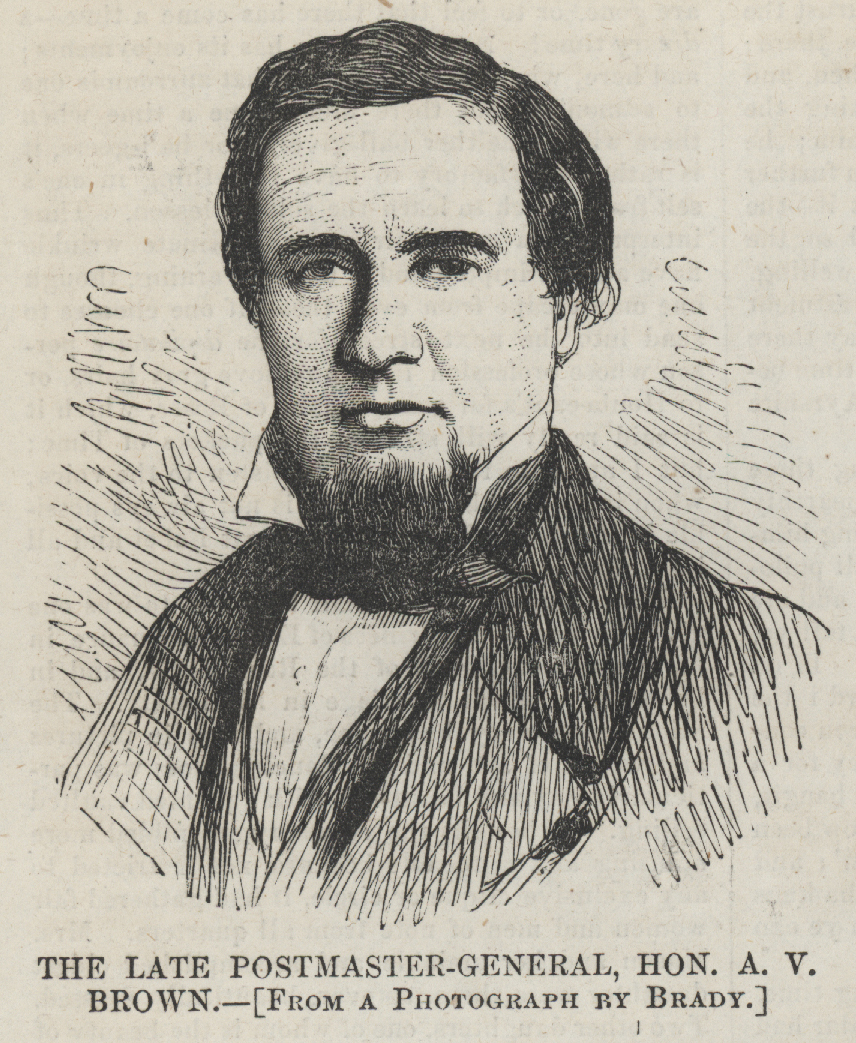
Page from Harper’s Weekly, March 19, 1859, with prints and articles, including a head and shoulders print of Aaron Brown, captioned, “The Late Postmaster-General, Hon. A. V. Brown.—[From a Photograph by Brady]” and related article reading, “The Late Postmaster-General Brown. On Tuesday, 8th, Postmaster-General Aaron V. Brown died at Washington. His friends will be glad to see the accompanying portrait. Mr. Brown was a Virginian by birth, and at the time of his death was about sixty-four years of age. His father commenced life as a revolutionary soldier, but ended it as a Methodist clergyman. He was fortunately able to give his son a good collegiate education. At the age of eighteen, the family having migrated to Nashville, Tennessee, young Aaron commenced the study of law in the office of Judge Trimble of that place, and in 1817 was admitted to the bar. According to the Herald, his maxim was to be ‘always first at court, and never leave till the order of adjournment is given.’ With such a rule for his guide, professional success was certain. For twenty-two years—the fact deserves consideration at the hands of young lawyers of the present day—Mr. Brown never suffered politics to rob his clients of an hour of his time. Though his talents naturally attracted the attention of his fellow-citizens, and the political success of his partner (Ex-President James K. Polk) would easily have opened to him the door of political advancement, he steadily refused to leave his home until he had ‘served his time’ as a practicing lawyer, and accumulated an ample fortune. He consented to serve as a Member of the State Legislature of Tennessee, because this did not involve any sacrifice of his clients' interests. But to Congress, however pressed, he did not go till the year 1839. In Congress Mr. Brown took an active part in the debates and business of the day. He was Chairman of the Committee on Territories, and as such secured a place in history by becoming the father of the bill securing a territorial government to Oregon. ln politics he was a strong Southern man, warmly opposed to the doctrines especially known as Northern; but he was equally opposed to the schemes of the Southern disunionists. During General Jackson's life he was a zealous partisan of his projects, among others, the annexation of Texas. In 1845 he was elected Governor of Tennessee by a large majority over the Whig candidate. In 1847 he ran for the same office, but was defeated. He was a member of the Democratic Convention which nominated Mr. Pierce for the Presidency, and, as Chairman of the Committee, framed the famous Baltimore Platform. Various public stations were offered him by Mr. Polk and Mr. Pierce. He declined them all; but on the election of Mr. Buchanan he accepted a seat in the Cabinet as head of the Post-office Department. We should be happy to add—if we could do so honestly—that he had rendered that absurd Department efficient or self-supporting; but to do either was perhaps beyond his power or any man's. In private life Mr. Brown was much liked. His temper was genial, his manners engaging; all who knew him loved him. His family relations were exemplary, and no house in Washington has been more pleasant to visit than the one over which his wife presided.”/tiles/collection/6/6334.xml
Download this image
Close up of head and shoulders print of Aaron Brown, captioned, “The Late Postmaster-General, Hon. A. V. Brown.—[From a Photograph by Brady]”/tiles/collection/6/6106.xml
Download this image