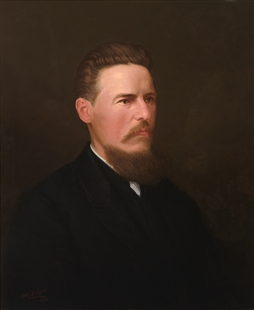
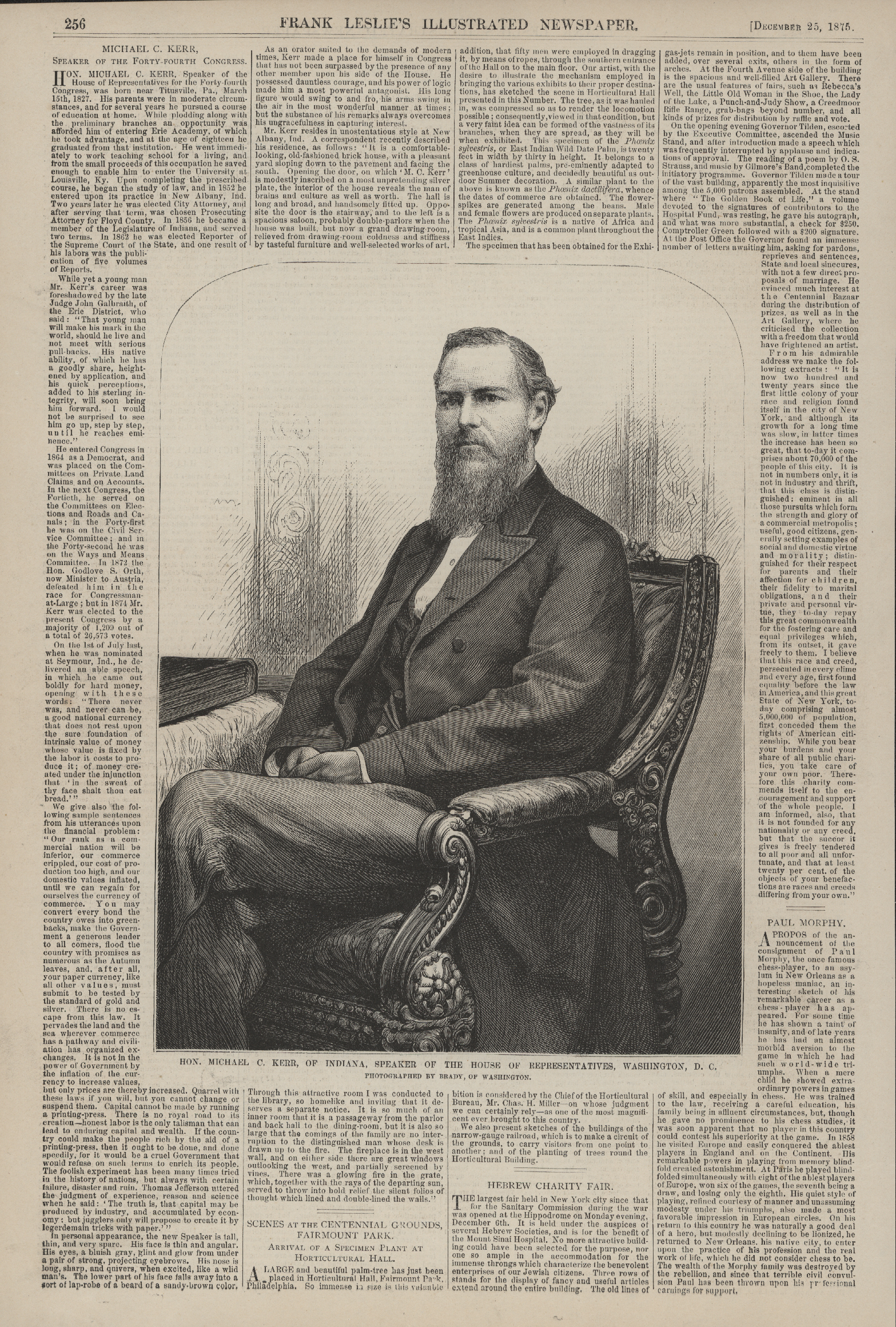
Hon. Michael C. Kerr of Indiana, Speaker of the House of Representatives, Washington, D.C.
Page from Frank Leslie's Illustrated Newspaper, with articles and a print of Michael Crawford Kerr seated in a chair, captioned, “Hon. Michael C. Kerr, of Indiana, Speaker of the House of Representatives, Washington D.C.” The first article reads, “Michael C. Kerr, Speaker of the Forty-Fourth Congress. Hon. Michael C. Kerr, Speaker of the House of Representatives for Forty-Fourth Congress, was born near Titusville, Pa., March 15th, 1827. His parents were in moderate circumstances, and for several years he pursued a course of education at home. While plodding along with the preliminary branches an opportunity was afforded him of entering Erie Academy, of which he took advantage, and at the age of eighteen he graduated from that institution. He went immediately to work teaching school for a living, and from the small proceeds of this occupation he saved enough to enable him to enter the University at Louisville, Ky. Upon completing the prescribed course, he began the study of law, and in 1852 he entered upon its practice in New Albany, Ind. Two years later he was elected City Attorney, and after serving that term, was chosen Prosecuting Attorney for Floyd County. ln 1856 he became a member of the Legislature of Indiana, and served two terms. In 1862 he was elected Reporter of the Supreme Court of the State, and one result of his labors was the publication of five volumes of Reports. While yet a young man Mr. Kerr's career was foreshadowed by the late Judge John Galbraith, of the Erie District, who said: ‘That young man will make his mark in the world, should he live and not meet with serious pull-backs. His native ability, of which he has a goodly share, heightened by application, and his quick perceptions, added to his sterling integrity, will soon bring him forward. l would not be surprised to see him go up, step by step, until he reaches eminence.’ He entered Congress in 1864 as a Democrat, and was placed on the Committees on Private Land Claims and on Accounts. In the next Congress, the Fortieth, he served on the Committees on Elections and Roads and Canals; in the Forty-first he was on the Civil Service Committee; and in the Forty-second he was on the Ways and Means Committee. In 1872 the Hon. Godlove S. Orth, now Minister to Austria, defeated him in the race for Congressman-at-Large; but in 1874 Mr. Kerr was elected to the present Congress by a majority of 1,209 out of a total of 26,573 votes. On the 1st of July last, when he was nominated at Seymour, Ind., he delivered an able speech, in which he came out boldly for hard money, opening with these words: ‘There never was, and never can be, a good national currency that does not rest upon the sure foundation of intrinsic value of money whose value is fixed by the labor it cost to produce it; of money created under the injunction that ‘in the sweat of thy face shalt thou eat bread.’ We give also the following sample sentences from his utterances upon the financial problem: ‘Our rank as a commercial nation will be inferior, our commerce crippled, our cost of production too high, and our domestic values inflated, until we can regain for ourselves the currency of commerce. You may convert every bond the country owes into greenbacks, make the Government a generous lender to all comers, flood the country with promises as numerous as the Autumn leaves, and, after all, your paper currency, like all other values, must submit to be tested by the standard of gold and silver. There is no escape from this law. It pervades the land and the sea wherever commerce has a pathway and civilization has organized exchanges. It is not in the power of Government by the inflation of the currency to increase values, but only prices are thereby increased. Quarrel with these laws if you will, but you cannot change or suspend them. Capital cannot be made by running a printing-press. There is no royal road to its creation—honest labor is the only talisman that can lead to enduring capital and wealth. If the country could make the people rich by the aid of a printing-press, then it ought to be done, and done speedily, for it would be a cruel Government that would refuse on such terms to enrich its people. The foolish experiment has been many times tried in the history of nations, but always with certain failure, disaster and ruin. Thomas Jefferson uttered the judgment of experience, reason and science when he said: 'The truth is, that capital may be produced by industry, and accumulated by economy: but jugglers only will propose to create it by legerdemain tricks with paper.' ln personal appearance, the new Speaker is tall, thin, and very spare. His face is thin and angular. His eyes, a bluish gray, glint and glow from under a pair of strong, projecting eyebrows. His nose is long, sharp, and quivers, when excited, like a wild man’s. The lower part of his face falls away into a sort of lap-robe of a beard of a sandy-brown color. As an orator suited to the demands of modern times, Kerr made a place for himself in Congress that has not been surpassed by the presence of any other member upon his side of the House, He possessed dauntless courage, and his power of logic made him a most powerful antagonist. His long figure would swing to and fro, his arms swing in the air in the most wonderful manner at times; but the substance of his remarks always overcomes his ungracefulness in capturing interest. Mr. Kerr resides in unostentatious style at New Albany, Ind. A correspondent recently described his residence, as follows: ‘It is a comfortable-looking, old-fashioned brick house, with a pleasant yard sloping down to the pavement and facing the south. Opening the door, on which ‘M. C. Kerr’ is modestly inscribed on a most unpretending silver plate, the interior of the house reveals the man of brains and culture as well us worth. The hall is long and broad, and handsomely fitted up. Opposite the door is the stairway, and to the left is a spacious saloon, probably double-parlors when the house was built, but now a grand drawing room, relieved from drawing-room coldness and stiffness by tasteful furniture and well-selected works of art. Through this attractive room I was conducted to the library, so homelike and inviting that it deserves a separate notice. It is so much of an inner room that it is a passageway from the parlor and back hall to the dining-room, but it is also so large that the comings of the family are no interruption to the distinguished man whose desk is drawn up to the fire. The fireplace is in the west wall, and on either side there are great windows outlooking the west, and partially screened by vines. There was a glowing fire in the grate, which, together with the rays of the departing sun, served to throw into bold relief the silent folios of thought which lined and double-lined the walls.’”/tiles/collection/2/2287.xml
Download this image