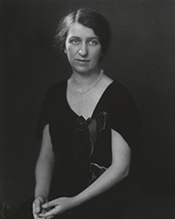
The first woman to serve in Congress from Pennsylvania,
Veronica Grace Boland only served for two months,
completing the term of her late husband, Patrick Joseph
Boland, the popular Democratic Whip who had died just
before winning a primary election. “I’ve always preferred
the background,” Congresswoman-designate Boland had
told the press upon her election.1 But her victory served
as a tribute to her husband. Postmaster General Frank C.
Walker, a family friend, told the Scranton Tribune that her
election “came as a deserved recognition of Mr. Boland’s
long public service.”2
Veronica Grace Barrett was born in Scranton,
Pennsylvania, on March 18, 1899, a daughter of Patrick and
Winifred Barrett, immigrants from Ireland. She graduated
from the Scranton Technical High School in 1918. She
later married Patrick J. Boland, a carpenter and building
contractor. They had two sons: Patrick Jr., and Eugene.
Patrick Boland went on to a political career, elected to
Scranton’s city council and school board before serving as
Lackawanna County commissioner from 1915 to 1919. In
1930 he was elected to a House seat as the nominee of the
Republican, Democratic, and Labor parties. This left Boland
free to choose which party caucus to join. He chose to
organize with the Democratic Caucus, which held a narrow
majority in the 72nd Congress (1931–1933). By his third
term, Boland became Democratic Whip and was briefly a
contender for Democratic Leader against Representative
John W. McCormack of Massachusetts, the eventual
winner, in 1940.3 Senator Joseph F. Guffey, the Democratic
leader of Pennsylvania, made retention of Boland as Whip
a condition before throwing the state’s House delegation
behind Sam Rayburn of Texas in his run for House
Speaker in 1937.4 Boland was credited with creating an
effective Whip organization, and he was praised for his
ability to determine how a vote would come out quickly
and accurately. One of his triumphs was assisting Speaker
Rayburn to extend the selective service system by one vote
just months before the Pearl Harbor attack in 1941.5
On May 18, 1942, Patrick Boland died suddenly of a
heart attack at home in Scranton, the morning before he
won nomination in the Pennsylvania primaries for another
House term. Majority Leader McCormack announced
Boland’s death by suggesting that wartime demands had
made Boland “a casualty of the present conflict.”6 His
death came at a time when Pennsylvania politics were
quite volatile. New Deal policies had made the Democrats
competitive in this predominantly Republican state, and
the Democrats were particularly concerned with avoiding
any potential fractures in their ranks.7 The executive
committee of the Pennsylvania Democratic Committee
turned to Veronica Boland, Patrick’s wife, to fill his
unexpired term on June 5, 1942. Running unopposed,
she won November 3.8 “I really can’t get excited about it,”
Boland told a group of reporters upon her election as
Pennsylvania’s first woman Representative. “I would rather
have Mr. Boland there, of course.”9 She chose not to run
for a full term in the 78th Congress (1943–1945), an
election that was held the same day as her special election.
At the same time, her willingness to serve out her husband’s
term bought the party’s executive committee some time
to settle upon a more experienced candidate for the
next Congress.
Boland was sworn in and seated on November 19, 1942,
less than a month before Congress adjourned on December 16.10
As a consequence, she received no committee assignments
and made no floor speeches.
After retiring from Congress, Veronica Boland returned
to Scranton and worked as an executive secretary for the
Dutch Manufacturing Company until 1957. She retired
when she underwent eye surgery.11 Boland died in Scranton
on June 19, 1982.
[ Top ]