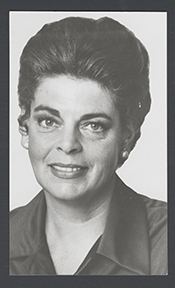
Politically connected by both birth and marriage, Helen
Stevenson Meyner entered elective politics for the first
time to serve New Jersey for two terms in the U.S. House
of Representatives. Congresswoman Meyner developed a
reputation as a thoughtful internationalist and advocate
of human rights issues. She also became a well-respected
charter member of the Congresswomen’s Caucus during her
short tenure in the House.
Helen Day Stevenson was born on March 5, 1929, to
William E. and Eleanor B. Stevenson. She had one sister,
Priscilla. The Stevensons worked for the American Red
Cross, establishing units in Europe and Africa during World
War I. William Stevenson later served as the president
of Oberlin College in Ohio and as U.S. Ambassador to
the Philippines. After graduating from Rosemary Hall
High School in Greenwich, Connecticut, in 1946, Helen
Stevenson earned her bachelor’s degree from Colorado
College in 1950. Immediately following graduation, she
served as a field worker for the Red Cross in Korea from
1950 to 1952 and then as a tour guide at the United
Nations. From 1953 to 1956, she was hired by a major
airline to travel around the globe on a promotional
tour under the name Mary Gordon. In 1956 Stevenson volunteered for the presidential campaign for her mother’s
distant cousin, Adlai Ewing Stevenson III. During the
campaign, she met New Jersey Governor Robert Meyner,
and they married in 1957. In 1970 Meyner lost a baby in
childbirth, and the couple had no other children. After
Robert Meyner left office in 1962, Helen Meyner began
writing a twice-weekly column for the Newark Star-Ledger,
which she continued until 1969. She also hosted a New
York–New Jersey television interview program from 1965
to 1968. Beginning in 1971, Meyner was appointed to the
New Jersey rehabilitation commission.
Admittedly more comfortable in the role of politician’s
wife, Meyner began her improbable political career in
July 1972.1 The Democratic nominee for a northeastern
New Jersey congressional district, Irish immigrant Joseph
O’Dougherty withdrew from the race because he had failed
to meet the U.S. Constitution’s seven-year citizenship
criterion. The state Democratic committee convinced
Meyner, who was at the time working on a biography of
writer Katherine Mansfield, to enter the race as the new
Democratic nominee in the heavily Republican district.
Despite her experience in politics, she admitted that, “in
the beginning, the adjustment to stand on my own and projecting myself in public was very difficult.”2 Initially
overshadowed by accusations that she supported an expensive
dam project because it benefited her own investments,
Meyner lost to Republican Joseph James Maraziti by a
margin of 56 to 43 percent in the general election.
Two years later, Meyner challenged Maraziti again. In
1974 her GOP opponent was compromised by revelations
that he kept a woman who did not work in his office on
his congressional payroll.3 This, coupled with the backlash
resulting from the Watergate investigation, gave Meyner
the edge. She defeated Maraziti, reversing the 1972 results
for a seat in the 94th Congress (1975–1977). Following
her victory, Meyner discussed the demands of a grueling
campaign: “They [the Democratic Party] package a
candidate like they’re selling some underarm deodorant.
Now I feel like I’m re-entering life after a long stay in a
hospital or prison.”4 Nevertheless, Representative Meyner
fought another close battle in 1976, barely holding off
Republican challenger William F. Schluter in the general
election. In a four-way race, Meyner emerged with 50
percent of the vote to Schluter’s 48 percent. She quickly
accustomed herself to her position as politician, rather
than politician’s wife. “I was always on the back of the
stage like most every other politician’s wife. And I was
always introduced as ‘Bob Meyner’s lovely wife, Helen,’”
she admitted to reporters. “I am still waiting, incidentally,
for someone to introduce my husband and me as ‘Helen
Meyner and her lovely husband, Bob.’”5
During her two terms in the House, Meyner served
on the Committee on the District of Columbia, the
Committee on Foreign Affairs, and the Select Committee
on Aging. She also was appointed to a relatively ceremonial
position on the House Beauty Shop Committee. In
order to take the seat on the prestigious Foreign Affairs
Committee (later International Relations), Meyner turned
down an assignment on the powerful Ways and Means
Committee, as the latter required Members to resign all
other assignments.6 While serving on the Foreign Affairs
Committee, Meyner criticized the nuclear arms race
and, most memorably, opposed attempts by nonaligned
nations to suspend or expel Israel from the United Nations.
She condemned the 1975 U.N. resolution that equated
Zionism with racism; however, she argued against using
the incident as a pretext for U.S. withdrawal from the
world organization.7 Meyner voted in favor of forming
a State Department board to oversee the creation of a center for conflict resolution. She amended an aid bill to
the Philippines which cut about $5 million in assistance
to punish Ferdinand Marcos’s authoritarian regime for
human rights abuses. Meyner told House colleagues in a
floor speech, “I believe that it is very important that we
send a concrete signal, and this would only be a signal, of
our concern for the serious human rights situation in the
Philippines. Words do not seem to have any effect. We must
show our concern in a more substantive way.”8
Meyner also used her seat on Foreign Affairs to tend to
New Jersey’s economic needs. She worked with her Garden
State colleagues to save her district’s Picatinny Arsenal from
closure; soon after, it was designated as the headquarters
for the Army’s Armament Research and Development
Command. She also sought to sustain New Jersey’s ailing
textile industry in the face of competition from foreign
imports. In late 1976, Meyner lobbied Democrats in the
New Jersey senate, urging them not to rescind the state’s
endorsement of the Equal Rights Amendment to the
Constitution. She subsequently participated in the 1978
Select Committee on Aging hearings on poor conditions in
boarding homes for senior citizens.
Meyner actively promoted women’s rights and their
increased involvement in politics. “A woman’s viewpoint is
different,” Meyner said upon her 1974 election, “perhaps
more intuitive and sensitive to people’s needs in the special
areas like day care, environment and education.”9 In her
first term, she supported legislation that aided destitute
women, including a vote to provide federal funding for
abortions through Medicare.10 As an active member of
the newly founded Congresswomen’s Caucus, Meyner
served as the organization’s resident expert on foreign
policy. She developed a reputation as an even-tempered,
thoughtful, and effective legislator, somewhat overshadowed
by her New Jersey colleague, Millicent Fenwick. In what
was later dubbed New Jersey’s “Year of the Woman,”
the more flamboyant Fenwick was elected to Congress
alongside Meyner in 1974; however, the two had an uneasy
relationship.11 After the caucus traveled to China in 1977,
the fiscally conservative Fenwick publicly rebuked Meyner
for spending taxpayers’ money to bring her husband on the
trip. Other Congresswomen, whose family members also
accompanied them, defended Meyner.12
In 1978 Meyner faced Republican James Andrew
Courter in another close election. High inflation, soaring
gas prices, and a lagging economy under the Jimmy Carter administration were prime issues during the midterm
elections. Running on a platform to improve economic
opportunities, Courter defeated Meyner by fewer than
6,000 votes, winning 52 to 48 percent. After leaving
Congress, Meyner returned to Princeton, New Jersey, where
she again worked for the state rehabilitation commission.
She also served on the boards of several major corporations,
where she developed a reputation for pushing women’s
equality in corporate management. After her husband’s
death in 1990, she moved to Captiva Island, Florida.
Meyner subsequently oversaw the establishment of the
Robert B. Meyner and Helen S. Meyner Center for the
Study of State and Local Government at her husband’s alma
mater, Lafayette College, in Easton, Pennsylvania. Helen
Meyner died on November 2, 1997, in Captiva Island.
[ Top ]