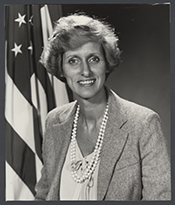
Lynn Martin’s expertise on economic issues, her quick wit,
moderation, and independence helped her to become the
first woman in the United States House of Representatives
to attain leadership positions high within the Republican
Party. As she had in the Illinois house of representatives,
Congresswoman Martin earned a reputation as a liberal on
women’s issues but also as a stalwart fiscal conservative eager
to rein in a government that, in her view, had spent beyond
its means since the 1960s. “All bureaucracy doesn’t have to
exist forever,” Martin said shortly after arriving in Congress.1
Judith Lynn Morley was born on December 26,
1939, in Evanston, Illinois, youngest of two daughters of
William Morley, an accountant, and Helen Hall Morley,
a department store clerk. She grew up on the north side
of Chicago in a heavily Irish-Catholic and Democratic
neighborhood and attended public schools. Her earliest
political experience was in running for eighth-grade class
president against her boyfriend. “I lost by one vote. My
vote. You see, I voted for my opponent because I thought
it was polite,” she recalled years later. “Well, he voted for
himself, and I learned my lesson: if you believe in yourself,
vote for yourself.”2 She made Phi Beta Kappa and earned
a BA in English at the University of Illinois at Urbana in
1960. A week after she graduated, she married John Martin,
an engineering student. They raised two daughters: Julia
and Caroline. Lynn Martin taught at several high schools in
DuPage County and Rockford, Illinois.
Martin entered public service after becoming “interested
in my community” and worried that the local government
was “out of touch” and “buried.”3 In 1972 Martin was
elected to the Winnebago County (Illinois) board and four
years later won a seat in the state house of representatives.
Her political mentors were Betty Ann Keegan, a Democrat
in the Illinois state senate who first encouraged her to
run for office, and Republican Congressman Robert
Henry Michel of Illinois, the future U.S. House Minority
Leader. She served on the appropriations committee and
earned the nickname “the Axe” for her efforts to reduce
spending.4 Martin won election to the Illinois senate in
1978. That same year, she and John Martin were divorced.
Lynn Martin eventually remarried in 1987 to Harry
Leinenweber, a U.S. District Court judge.
When U.S. Representative John Bayard Anderson
retired to run for the presidency in 1980, Martin beat four
other Republicans in the primary for the open seat in the
northwest Illinois district bordering Wisconsin. The largely
agrarian district was anchored by the town of Rockford
and had not sent a Democrat to Congress in the twentieth
century.5 Martin’s platform supported the Equal Rights
Amendment and abortion rights but was fiscally conservative,
calling for lower taxes and business deregulation. Her
socially moderate stance earned her the support of women’s
groups. In a state that went comfortably for Republican
presidential nominee Ronald Reagan in the general election,
Martin cruised to victory with 67 percent of the vote against
Democratic candidate Douglas R. Aurand. Though held to
less than 60 percent of the vote in 1982 and 1984, she never
was seriously challenged afterward.6 “I had an opportunity
to run for the House and wrestle with some things, like the
direction of growth in government,” Martin said shortly after
taking office. “I knew if I ignored the opportunity, then I’d
never have the right to complain about these things.”7
In Congress, Martin quickly became a leader within the
Republican Party. She possessed an encyclopedic knowledge
of economic issues and skewered Democrats (and some
Republicans) for what she identified as zealous spending
habits. Her mentor, Minority Leader Robert Henry Michel,
got Martin a seat on the Budget Committee in the 97th
Congress (1981–1983), a plum assignment for a freshman.
Martin explained, “It’s a little like getting sex education
at age six. It’s a little too soon to understand—there’s a lot
of stuff you shouldn’t know until a lot later.” Soon after,
Martin was plotting budget strategy with the Reagan White
House and clashing with the Defense Department, which
wanted to vastly expand military spending at the expense
of social programs.8 In 1986, during the committee’s
budget negotiations, Martin stood in for the ailing Ranking
Republican. She established a cordial working relationship
with Democratic Chairman William Herbert Gray III of
Pennsylvania, impressing observers with her acumen. In
1987, during a markup session on the budget, a question
arose over whether the committee should restore a revenue-sharing
program. Several of the men, both Republicans and
Democrats, made assertive arguments for restoration. Martin
balked, arguing that the deficit-strapped federal government
had no money to share with local governments. “Maybe girls
learn to say ‘no’ easier than boys,” she chided her colleagues,
drawing chuckles from many in the room.9
When New York Representative Geraldine Anne Ferraro
became the Democratic vice-presidential candidate in 1984,
Martin played a prominent role in steering Republican
national strategy. First, she became Vice President
George H. W. Bush’s sparring partner, a stand-in for Ferraro
to prepare for the fall debates. She adopted an aggressive
style in those mock debates, throwing the Vice President
off balance and convincing him that he needed to prepare
more rigorously. Martin also was tapped to deliver Bush’s
nominating speech at the Republican National Convention in
Dallas. The party named her chair of the Reagan–Bush Illinois
campaign. When Bush ran for President in 1988, she was the
only woman named a national co-chair of his campaign. After
the 1984 election, she also won the historic distinction of
being elected vice chair of the House Republican Conference,
the first woman ever to serve in the House GOP leadership.
She was re-elected to the post two years later. In 1988, when
Conference Chair Richard Bruce Cheney of Wyoming opted
to run for the party’s second highest position of Whip, Martin
entered the race for his vacant leadership spot. She lost her
bid by only three votes to Charles Jeremy (Jerry) Lewis of
California after party conservatives mounted a campaign
against her, in part, for her voting record on social issues.10
Martin avoided labels such as “crusader” or “feminist.” She
once exclaimed, “I don’t walk into every meeting humming,
‘I Am Woman.’”11 In the 100th Congress (1987–1989), she
waged a successful campaign to bring 30,000 congressional
employees under the protection of the 1964 Civil Rights Act
(from which they had been exempt). It was, in large part, an
effort to improve working conditions, reduce discrimination,
and to raise the pay for women staff members whom Martin
demonstrated were consistently underpaid.12 She wanted to
help women by providing economic opportunity, rather than
direct government aid. “In a recessive economy,” Martin said
in 1981, “the people the most hurt are minority women. So
the best place I could help would be to get it going again. If
we’re in a recession—if there are no jobs—programs don’t
mean a thing.”13
Martin distinguished herself on several other committees,
serving on House Administration during the 97th and 98th
Congresses (1981–1985), Public Works and Transportation
during the 98th Congress (1983–1985), Armed Services
during the 99th through 100th Congresses (1985–1989),
and Rules in the 101st Congress (1989–1991). On a
number of important issues, she parted company with
Republicans: arguing for a minimum wage increase, voting
to override President Reagan’s 1986 veto of a sanctions bill
against the apartheid regime in South Africa, joining with
Democrats to stiffen punishment for white-collar criminals,
and supporting abortion rights legislation.
In 1990 President Bush and other Republican leaders
convinced Martin to give up her House seniority to
challenge incumbent Democrat Paul Martin Simon for
one of Illinois’s U.S. Senate seats. Observers thought it
would be a close race. Martin’s campaign suffered from
several gaffes and a lack of funding (Simon outspent her by
a nearly two-to-one margin).14 Both candidates supported
abortion rights, though Simon managed to win support of
the Women’s Campaign Fund because of his connections
to that group’s major donors. It was a blow to Martin’s
cash-strapped campaign. Simon also was able to capitalize
on wide public support for Operation Desert Shield, the
military buildup leading up to the Gulf War, by generating
publicity from his seat on the Senate Foreign Relations
Committee; he appeared on television with the troops in
Saudi Arabia.15 Martin lost in a landslide as Simon scooped
up 65 percent of the vote.16
Martin’s supporters in the party helped her in her
postcongressional career. On December 14, 1990, President
Bush appointed her Secretary of Labor, despite the fact that
she was at variance with the administration on social issues.
“I can’t imagine the only people who should work for a
President are those who sycophantically agree on everything,”
Martin said. “It would be the most boring Cabinet in the
world and it would be of no use to the President.”17 She
served as Labor Secretary from February 22, 1991, until
January 20, 1993, developing several programs: “Job Training
2000” for youth apprenticeships, the Pension Opportunities
for Worker’s Expanded Retirement, and the “Glass
Ceiling” Initiative. Martin later taught at Northwestern
University, worked for Deloitte & Touche’s Council on the
Advancement of Women, chaired a University of Illinois task
force on “The Future of the Health Care Labor Force in a
Graying Society,” and conducted a comprehensive study on
sexual harassment in the workplace for a major automobile
company.18 She lives in Chicago, Illinois.
[ Top ]