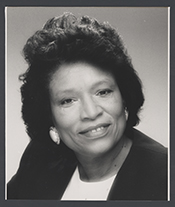
In 1992, Eva M. Clayton won election to the U.S. House
of Representatives to become the first African-American
woman to represent North Carolina in Congress and the
state’s first Black Representative since 1901. From her post
on the House Agriculture Committee, Clayton advanced
the interests of her rural district in northeastern North
Carolina and called attention to the economic inequalities
that affected African Americans nationally. Years after
leaving the House, Clayton reflected on why she entered
public service. Politics, she explained, contained “the
possibility that I could help, that I could serve, I could make
a difference.”1
Eva Clayton was born Eva McPherson in Savannah,
Georgia, on September 16, 1934. She grew up in North
Carolina and received a bachelor’s degree in biology from
Johnson C. Smith University in Charlotte, North Carolina,
in 1955. In 1962, she earned a master’s degree in biology
and general science from North Carolina Central University
in Durham. She planned to become a doctor and travel to
Africa to do missionary work. Shortly after receiving her
undergraduate degree, Eva McPherson married Theaoseus
T. Clayton, who became a prominent lawyer. They had four
children—Theaoseus Jr., Martin, Reuben, and Joanne—
and while raising her family, Clayton turned her attention
away from medicine and enrolled in law school, first at
North Carolina Central University and then at University of
North Carolina. Having to shoulder the responsibilities of
both home life and classwork, however, Clayton reluctantly
withdrew from law school after the birth of her fourth
child. “I wasn’t super enough to be a supermom,” Clayton
recalled years later. “I left to be a mom. My husband was
supportive, but I felt enormously guilty. I think I would do
it differently now. I think I would know how to demand
more of my husband.”2
During the 1960s, the civil rights movement motivated
Clayton to become active in civic and political affairs. At
one point, she picketed her husband’s law office to protest
his and his White law partner’s ownership of a building that
contained a segregated restaurant. In 1968, Eva Clayton was
recruited by civil rights activist Vernon Jordan, head of the
Voter Education Project, to run for Congress in a north-central
North Carolina district. Clayton won 31 percent
of the vote in the Democratic primary, but the incumbent,
Lawrence H. Fountain, prevailed. “In 1968, the timing
wasn’t there,” she later observed. Despite her loss, Clayton’s
campaign had mobilized volunteers and built a “kind of
community organization” that successfully increased Black
voter registration and participation.3
In the early 1970s, Clayton worked for several public
and private ventures, including the North Carolina health
manpower development program at the University of North
Carolina. At the time, Clayton and her husband were
involved with Soul City, a planned community in rural
North Carolina created by lawyer and civil rights activist
Floyd McKissick with the intention of being “black owned
and operated.” In 1974, Clayton cofounded and served as
the executive director of Soul City Foundation, a nonprofit
funded mostly through the grants provided by the federal
government to offer meal programs, health fairs, and other
opportunities to Soul City and the surrounding area. Two
years later, she worked on the successful gubernatorial
campaign of Jim Hunt, who later appointed Clayton the
assistant secretary of the North Carolina department of
natural resources and community development. Clayton
served as assistant secretary from 1977 until 1981 and
developed “a feel for the interrelationship between state
and federal government.” After leaving state government,
she founded an economic development consulting firm.
In 1982, she won election to the Warren County board of
commissioners, which she chaired until 1990. Over the next
decade, Clayton helped steer more than $550 million in
investments into the county and successfully passed a bond
issue for the construction of new schools.4
When Representative Walter Beaman Jones Sr.
announced his retirement in 1992, Clayton entered the
Democratic primary to fill his seat. In contrast with her
1968 campaign, Clayton faced a more favorable electorate
and had developed a wealth of experience in state politics
and local economic development. Recently redrawn by
the state legislature, North Carolina’s First District was
one of two new districts in the state with a Black majority.
On the campaign trail, Clayton emphasized her career
accomplishments and long-standing relationship with
district residents. “I have a record, and I’ve demonstrated to
you I care. . . . I care about rural areas. I care about poverty.
I care about you.”5
After Jones died in September 1992, his son Walter
Beaman Jones Jr., who was considered the favorite in the
Democratic primary, captured 38 percent to Clayton’s 31
percent. But because he fell two points shy of winning the
nomination outright, the race moved to a runoff. Clayton
consolidated the support of her other primary opponents
and won the nomination with 55 percent to Jones’s 45
percent. In the general election, Clayton ran on a platform
of increased public investment and job training for rural
areas in the district, which covered a large swath of eastern
North Carolina including the towns of Goldsboro, Rocky
Mount, and Greenville. She advocated slashing the defense
budget to lower the federal deficit. “We went into the
projects and knocked on doors and got people out” to vote,
Clayton recalled.6
On November 3, 1992, she won the special election
to fill the last two months of Walter Jones Sr.’s unexpired
term in the 102nd Congress (1991–1993) and defeated
Republican Ted Tyler for a full term in the 103rd Congress
(1993–1995). Although Melvin L. Watt, another Black
candidate running in North Carolina that year, also won on
November 3, Clayton’s simultaneous election to the 102nd
Congress meant that she became the first African-American
Representative from North Carolina since George Henry
White in 1901. Clayton defeated Tyler in her next three
re-elections, taking 60 percent or more of the vote. In 1998,
the third time she faced Tyler, state courts had redrawn the
district by adding 165,000 new constituents and shrinking
the African-American majority by 7 percent, effectively
dividing the district between Black and White constituents.
In 2000, the GOP ran Duane E. Kratzer Jr., who managed
just 33 percent of the vote to Clayton’s 66 percent.7
Clayton claimed her seat in the 102nd Congress on
November 5, 1992, but she did not receive committee
assignments until the 103rd Congress convened in January
1993. She won spots on the Agriculture and Small Business
Committees. Clayton eventually became the ranking
Democrat on the Agriculture Committee’s Operations,
Oversight, Nutrition, and Forestry Subcommittee. Clayton
also became the first Democratic woman to serve as
president of her class of freshman lawmakers. In 1995, she
was appointed to the Democratic Advisory Committee to
formulate party strategy. In the 105th Congress (1997–
1999) she dropped her Small Business assignment for a seat
on the prestigious Budget Committee. Clayton was also
assigned to the Social Security Task Force.
Clayton was a staunch defender of the rural and
agricultural interests of her district, which comprised 20
counties with numerous peanut and tobacco growers. Along
with Missouri Republican Jo Ann Emerson, she revived
the Rural Caucus and rallied more than 100 Members to
pledge continued federal aid to farmers, new rural jobs,
and technology initiatives. In 1993 and 2000, respectively,
Clayton voted against the North American Free Trade
Agreement and Permanent Normal Trade Relations with
China, insisting that both would adversely affect the
agricultural industry and eliminate low-wage jobs from her
district. “Must eastern North Carolina lose in order for the
Research Triangle to win?” she asked, alluding to the state’s
booming high-tech corridor to the west of her district.
Although Clayton advocated smaller defense budgets,
she remained supportive of naval contracts for projects
at the nearby Newport News shipyards, which employed
her constituents.8
From her seat on the Agriculture Committee, Clayton,
unlike many of her Democratic colleagues, supported
extending tobacco subsidies to farmers at a time when
critics sought to cut back the program. “This is not about
smoking,” Clayton said. “This is about discriminating
against the poorest of the poor of that industry. . . . They
really are attacking the small farmer.” She also fought
successfully to preserve Section 515 of the U.S. Agriculture
Department’s affordable housing program, which provided
federal loans for multi-unit housing projects in rural areas.9
Clayton addressed food security and hunger as a member
of the Agriculture Committee. She defended funding for
food stamps and successfully fought to make documented
immigrants eligible for the program. She traced her
advocacy for food security to her mother. “Because of my
age and also the segregation, we didn’t have a lunchroom
[at school]. …But my mother became the president of
the PTA, and she was insistent that there be a lunchroom.
They made a lunchroom out of almost a school closet where
they kept books, and she and one other person, they would
rotate. Finally, the school began giving oranges and fruit,
and that was the beginning of a lunchroom.”10
In 1999, Clayton’s district suffered a major natural
disaster when rain from Hurricane Floyd caused rivers to
swell, flooding some parts of eastern North Carolina under
14 feet of water. Clayton and other Members of the state
delegation secured billions in relief aid. Clayton helped obtain
$1.5 million in federal money to reconstruct a dike along
the Tar River in Princeville, one of the nation’s first towns
chartered by free African Americans after the Civil War.
She also joined a volunteer force of more than 500 people
to help flood victims throughout eastern North Carolina.11
As she gained seniority and power in the House, Clayton
became a prominent advocate for programs to help poor and
working-class African Americans. Throughout her career, she
stressed the importance of job training. “The issue of equity
in jobs and fairness of opportunities is paramount,” Clayton
said. “Job opportunities combined with a fair wage are key to
strengthening families and communities and increasing our
quality of life.” As chair of the Congressional Black Caucus
Foundation, a nonprofit associated with the Congressional
Black Caucus, Clayton worked with mortgage lenders to
establish the “With Ownership, Wealth” (WOW) program.
The WOW program sought to help African American
homebuyers through financial education programs and
assistance in down payments and closing costs. Clayton’s
goal for WOW was to “help bridge the huge racial divide in
homeownership rates.” In 1996, she also played a key part
in fighting GOP efforts to cut summer job programs for
young people. Declaring that she intended “to wake up” the
House, Clayton said that the programs helped more than
615,000 job seekers in 650 cities and towns. “This is the first
opportunity many of these young people have to get a job.”12
In the mid-1990s, amid a push on Capitol Hill to reform
the nation’s welfare system, Clayton urged lawmakers to
keep individuals and families at the forefront of their work.
“The family cannot be a footnote that is added at the end of
this reform, but should be an integral part of this legislation
in its infancy,” she told the Ways and Means Committee in
1994. As welfare legislation advanced in the House, Clayton
advocated for a raise in the minimum wage and for federal
funding to help prevent teenage pregnancy. When the
Personal Responsibility and Work Opportunity Act came
to the floor in the 104th Congress (1995–1997), Clayton
voted against it. In 1994, Clayton supported the Violent
Crime Control and Law Enforcement Act believing “it had
more positive features to fight crime in our communities
than had troubling provisions,” she explained. Even as
the Congressional Black Caucus pulled its support and
criticized the bill, saying it lacked protections against racial
discrimination, Clayton remained in favor of it.13
In November 2001, Clayton declined to seek
renomination to a sixth term in the House. She had been
successful in intense negotiations with state legislators to
ensure that her predominantly African-American district
was “protected” during reapportionment after the 2000
Census. “My heart is leading me somewhere else,” Clayton
said. “I don’t know exactly where that is, but I do want
to have another opportunity for public service before I
really hang it up.” In the fall 2002 elections, Clayton was
succeeded by Frank W. Ballance Jr., a Black state legislator.
After retiring in January 2003, Clayton became the assistant
director-general of the United Nations Food and Agriculture
Organization, which focused on combatting global hunger
from its headquarters in Rome, Italy. She remained in that
position for three years before returning to her home in
Littleton, North Carolina.14
[ Top ]